11 — Dashboard · UI/UX · IoT integrations · Hosting

Villa Ekbacken

One screen for a house of nine protocols.

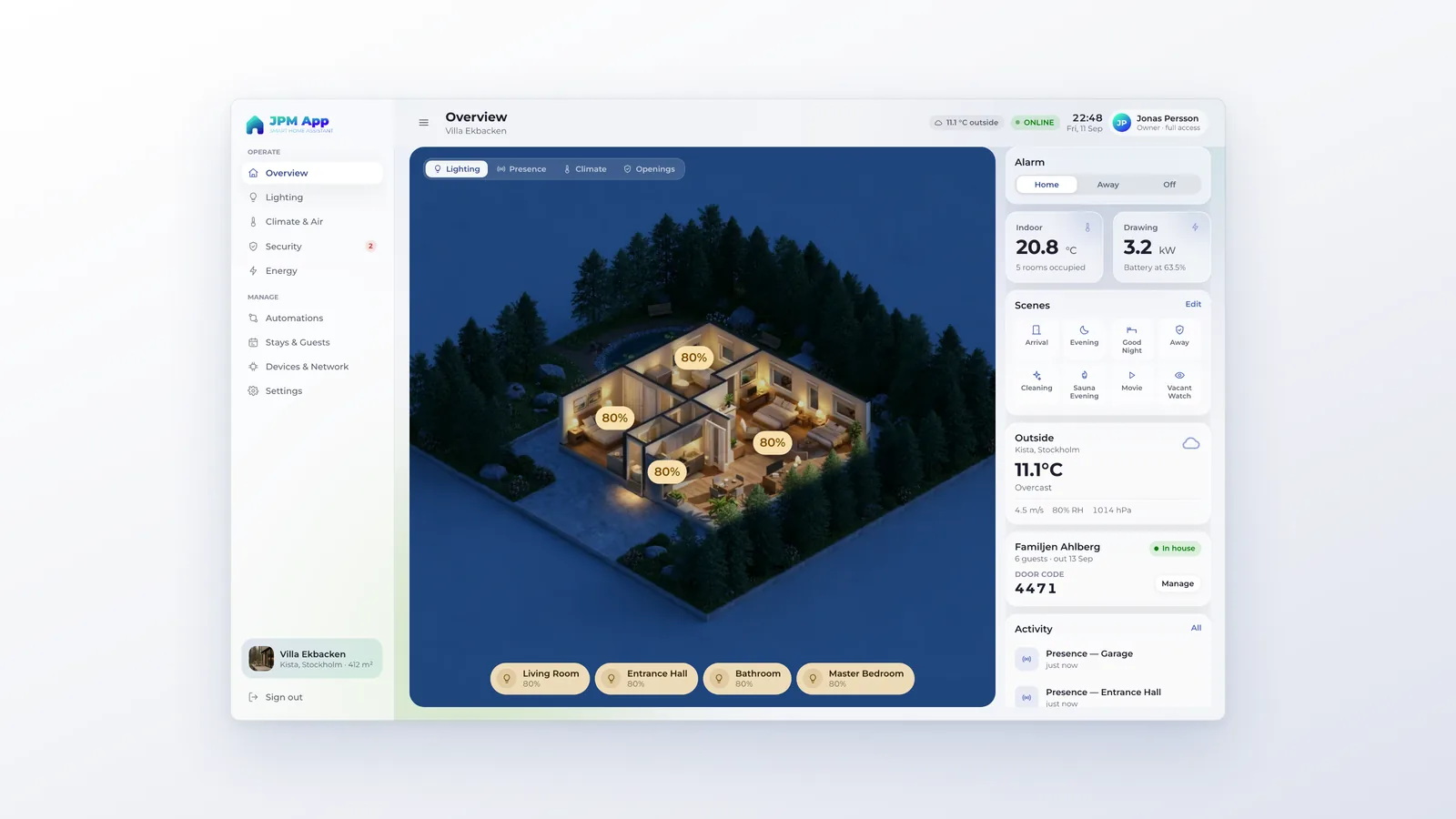
The owner of a private residence had devices from several makers, each with its own app. We scanned the house, designed a console around its plan, joined nine protocols over MQTT with local rules that survive an outage, and support it since.

Villa Ekbacken — One screen for a house of nine protocols.
Client
Villa Ekbacken (JPM)
Sector
Private residence, 412 m²
Scope
Scan, console, IoT, integrations, hosting
Delivered
18 weeks · ongoing support
What it runs
412 m²
One private residence
60
Devices in the registry
9
Protocols, from Zigbee to KNX
11
Rooms and zones on the plan

The anonymised model of the house.

  1. The problem

    A house run from six apps.

    Lighting, heating, locks, cameras and energy each came from a different maker. Checking the house meant switching between apps, and nothing worked together or without the internet.

  2. What we did

    The plan of the house became the interface.

    We scanned the residence, rendered it by day and night from one camera and designed a console where rooms light up on the plan. Sixty devices on nine protocols meet over MQTT, and safety rules run locally inside the house.

  3. The outcome

    Most of it now runs itself.

    In the first year 86% of repeated actions ran automatically, energy use fell by a quarter and preparing the house for arrival went from 42 minutes to 4. One leak closed the water in 7 seconds.
The film
The five-second ad: nine protocols, one screen.
How it ran

From a scan to a console.

  1. Survey & scan
  2. Digital twin
  3. UX & Figma
  4. Console build
  5. MQTT & devices
  6. Commissioning & training

A diagram of how the work was arranged, not a timed schedule. The first prototype came on day twelve; four zones were under control in week six.

What we were given
  • A private residence
  • Devices from several makers
  • An owner who wanted one screen
What we delivered

Survey & design

  • LiDAR scan and 3D model
  • Day and night renders
  • Console designed in Figma

Console

  • 10 screens, overview to settings
  • 8 scenes and 12 rules
  • Guest access with timed PINs

IoT & integrations

  • MQTT broker and edge gateway
  • 60 devices on 9 protocols
  • Tariff, weather, EV and SMS links

Launch & care

  • Server, CI/CD and backups
  • Training for owner and staff
  • Monitoring and support
From a sensor to a person

Critical events escalate on their own.

A critical event goes to the working group at once. If nobody confirms within four minutes it goes to the manager by SMS; after ten, to the owner and the engineer on duty.

  1. Where events start
    • A leak sensor
    • A smoke detector
    • A door under alarm
    • A lost broker connection
  2. What the house does first
    • Closes the water
    • Opens the exit paths
    • Turns on full light
    • Switches to local rules
    Runs locally, without the internet
  3. Who is told
    • The working group in Telegram
    • The manager by SMS
    • The owner
    • The engineer on duty
The identity

Mark, wordmark, palette and face are the product's own, set here in code.

JPM App
JPM App
  • Control blue#4C65BA
  • Mint#41FEC3
  • Violet#3600FA
  • Cold white#F3F4F7
  • Night#08151C
Montserrat · Light to Bold

The house is the interface.

Arrival · Evening · Good Night · Sauna Evening

  • JPM AppLeak closed · 7 sCritical alert
  • JPM AppEveningScene button
  • JPM AppGuest PIN · Fri–SunTimed access card
The brand outside the screen

Proposed applications, made for this case — not photographs of the residence.

  • The climate panel beside the heating manifold
  • The overview in the boot room, February
  • The house at blue hour, the garage screen lit
  • The console on the kitchen wall at 07:30
  • Energy beside the EV charger
  • The mark on a brushed-steel faceplate
In their words
Iexpectedeasycontroloflightsandheating,butNoemolookedatthehouseasoneproduct.Theystartedwithascan,workedthroughtheengineering,drewtheinterfaceforthishouseandconnectedsystemsthatneverknewabouteachother.Iseethestateofthehouseinseconds,andthecriticalscenariosrunlocally,withoutthecloud.
Noem BillOwner, Villa Ekbacken
  • The hard part was not connecting the devices but making different protocols behave like one system. The owner sees a simple interface; the technical team sees the signal, firmware, broker and history of every node.
    Zaff OrlovIntegration engineer
What it brought
  1. 86%Of repeated actions run automatically
  2. −24%Energy use in the first year
  3. 42 → 4 minTo prepare the house for arrival
  • 7 sFor a leak to close the water
  • 184 msMedian command confirmation
  • 0Critical events lost in outages

Next case

Start a project

The next onestarts here.

Tell us what you are building. If it is a fit you will have an offer — and if not, we’ll tell you upfront.

Prefer to writehej@noemo.se

This site uses cookies. The necessary ones are already on; the rest wait for you. Cookie policy

Necessary

Remembers the answer you give here and keeps the site working. There is nothing else in this group.

Always on

Analytics

Counts visits, shows us which pages are read, and records how a page is used — never what you type into a form. Off until you turn it on.

Marketing

Would let us see which advertisement brought you here. Nothing is in this group today, and we will ask again before anything is.